Improve Child Welfare Investigations and End Malicious Reporting: Support the Anti-Harassment in Reporting Bill
What’s Wrong with the Current System?
Malicious and unreliable reports have become commonplace in New York because state law allows anyone to call the child maltreatment hotline and make anonymous allegations. Most people who call the state hotline to report suspected abuse or neglect are mandated reporters, who are required to give their name and contact information. Yet individuals with no specialized training who call to make reports are not currently required to give their name or any contact information.
State law requires child protective services to conduct an extensive investigation of every allegation of child abuse or neglect, even if there is no evidence or the report is part of a pattern of harassment. This means anonymous individuals can use the system to harass others repeatedly and without reprisal.
Bad actors have taken advantage of this loophole. Empirical evidence demonstrates anonymity fosters harassing behavior. Abusive partners, angry exes, unscrupulous landlords, and feuding neighbors use anonymous reporting to call in false allegations against parents. Domestic violence survivors in particular report that abusers routinely use the anonymous reporting system to harass their former partners and their children.
Anonymous Reports are Notoriously Unreliable
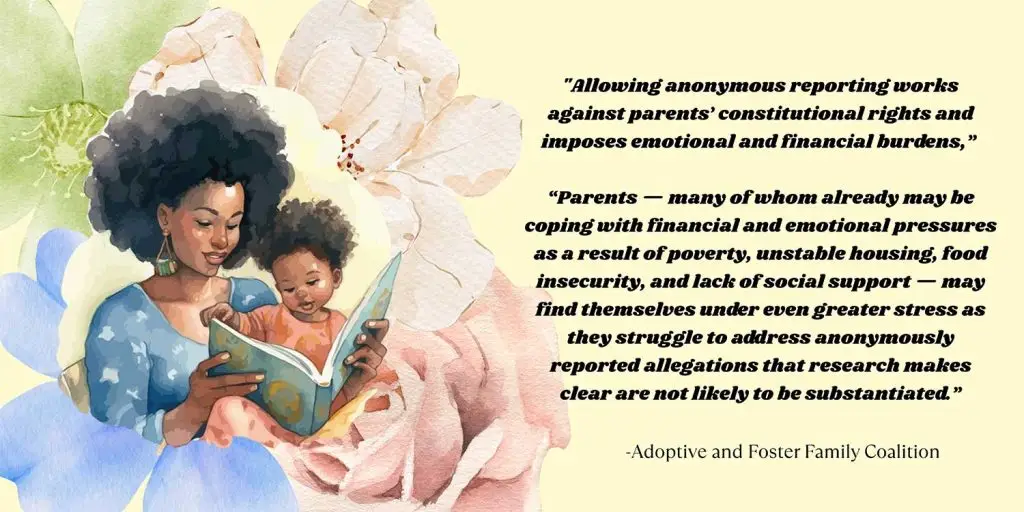
Of parents investigated on the basis of an anonymous report, over 86% are cleared of all wrongdoing after an initial investigation, and even more are ultimately cleared when they have the opportunity to challenge the accusations in court or an administrative hearing.
Parents placed under investigation because of an anonymous report are more than twice as likely to be cleared of any wrongdoing as are parents investigated because of other report types.
Unjustified Investigations Harm Children and Families
Investigations last for months and are often extremely invasive.
The process is stressful to parents, who have their homes searched, are subjected to repeated surprise visits, are expected to miss work for investigatory meetings, and may face the loss of their jobs or stigmatization by their communities.
The disruption can be even more traumatic to children, who often are woken in the middle of the night, questioned by investigators, and sometimes strip searched.
Throughout the process, parents and children live in fear that they might be torn apart. Families who have endured these investigations report that the psychological and financial consequences persist long after the case is closed.
Anonymous Reporting is a Racial Justice Issue
Black, Native American, and Latinx families bear the heaviest burden of child welfare system involvement throughout New York State. Black families in particular are significantly more likely to be reported, investigated, given records that limit employment, and forcibly separated than are families of any other race. In New York City, for example, Black families are 5 times more likely than white families to be reported to the child abuse hotline, 7 times more likely to have a case indicated, and 14 times more likely to be separated. The child protective system uses the targets the same communities and uses the same tools as over-policing by law enforcement, which is why refer to this system as the family policing system.
What Would the Anti-Harassment in Reporting Bill Do?
This bill offers a simple solution to dramatically reduce the number of malicious false reports: require that every caller provide their name and contact information when making a report to the hotline. This information would be kept confidential from the public and from the person accused of abuse or neglect, while allowing child welfare investigators to conduct a full and more reliable investigation. This commonsense fix will help shield families from unjustified investigations and improve the accuracy, efficiency, and integrity of child welfare investigations.
Confidential Reporting will Protect Reporters’ Privacy
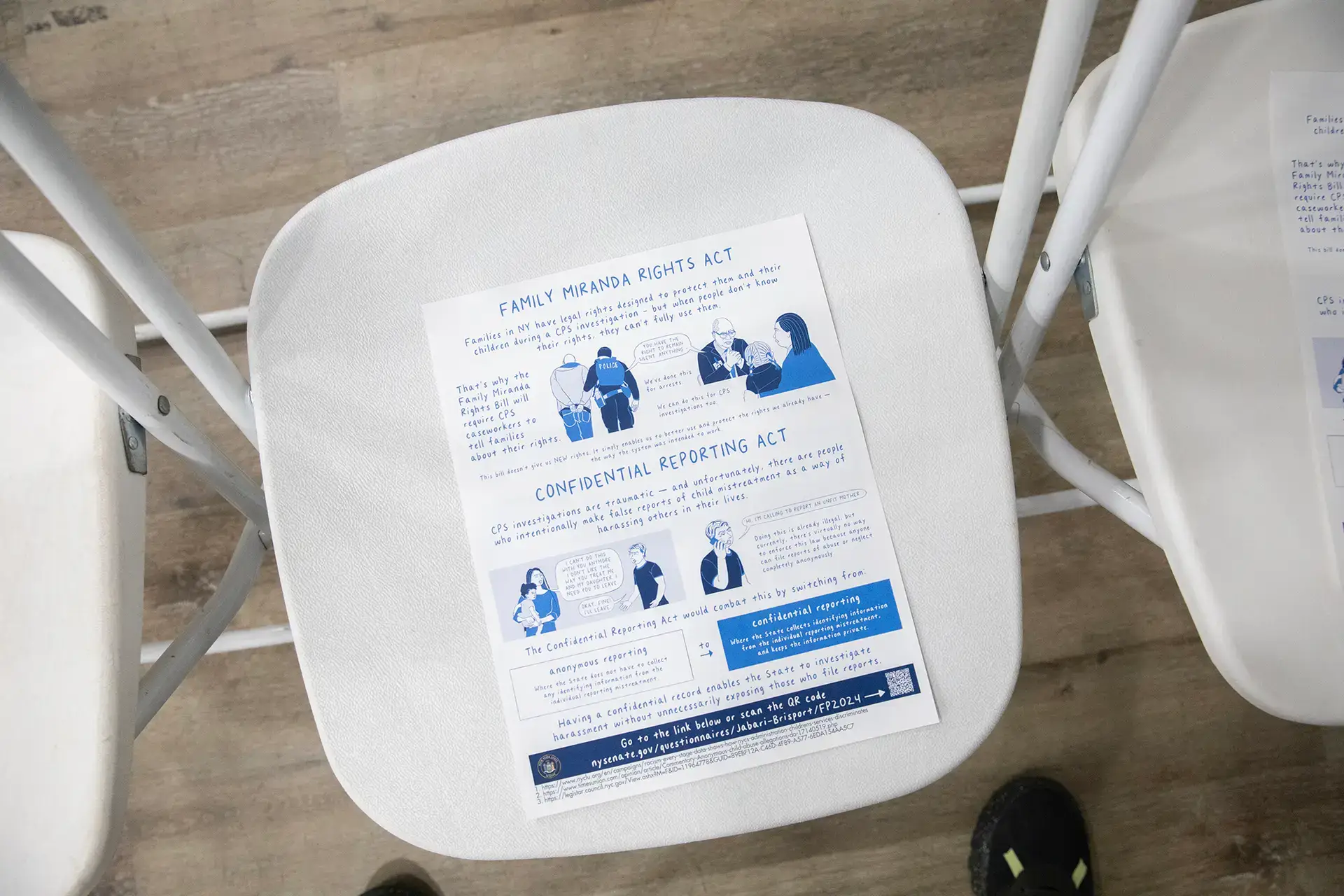
The bill would change the standard from anonymous reporting (where no identifying information is provided to the hotline workers) to confidential reporting (where the child welfare workers can see who made the report, but no one else can).
New York law requires that reports to the hotline be kept strictly confidential except in extremely limited circumstances. Even in such rare where some information in a report is released, there are strong protections in place to maintain reporters’ confidentiality. This confidential reporting policy is designed to ensure anyone can come forward to report without fearing repercussions. The Anti-Harassment in Reporting Bill will preserve this confidential reporting policy and continue to protect reporters’ identifying information.
Confidential reporting accomplishes the same privacy goals as anonymous reporting without creating cover for intentionally false reports.
Confidential Reporting will Improve Child Welfare Investigations
Anonymous reporting hurts the accuracy and integrity of investigations. Investigators have a duty to investigate whether a report has merit, and this process is smoother and more complete when they can follow-up on a call. This allows them to understand the basis of the knowledge, when the suspected maltreatment occurred, who was involved, and the impact on the child. With anonymous reports, investigators are deprived of necessary information for a thorough investigation. Additionally, anonymous reporting denies investigators the opportunity to assess the reporter’s credibility or motives and no way of determining whether the person has a pattern of making false reports.
These false reports force local child welfare agencies to waste valuable time and resources running down spurious complaints. This approach hurts the children it is intended to help by diverting resources away from the families that could actually benefit from intervention.